Water Damage Restoration
The core service: assessment, extraction, drying, cleaning and repairs coordinated as one restoration scope.
Water damage restoration in Florida →
Skyfold Restoration · Florida
Florida Property Restoration for Water, Fire, Mold, Smoke & Biohazard Damage
Florida water damage restoration for homes and businesses, with water extraction, structural drying, flood cleanup, storm damage, fire, smoke, mold and biohazard restoration support.
Service availability should be confirmed for the specific property location.
Emergency water damage
When water enters a property, the first priority is safety and source control where it can be done safely. Electrical hazards, contaminated water, unstable materials and active leaks may require professional assistance rather than DIY cleanup.
Visible water is only part of the problem. Drywall, flooring, insulation, subflooring and cabinetry can retain moisture. Extraction removes bulk water, structural drying addresses the moisture that remains, and monitoring helps show whether materials are drying.
Water damage restoration is a process rather than a single cleanup task. The exact scope depends on the source of the loss, the amount of water, affected materials, property type and resulting moisture conditions.
The core service: assessment, extraction, drying, cleaning and repairs coordinated as one restoration scope.
Water damage restoration in Florida →Remove standing water from affected areas before deeper structural drying begins.
Water extraction services →Address affected surfaces, debris and contents according to the source and condition of the water.
Water damage cleanup →The hub for moisture detection, dehumidification, air movement, drying monitoring and moisture verification.
Structural drying process →Tools used within structural drying to locate hidden moisture and control water vapor as materials dry.
See how drying is monitored →Address flood-related water intrusion through assessment, extraction, drying and restoration as required.
Flood damage restoration →Restore water damage from roof intrusion, wind-driven rain, storm flooding and related events, starting with emergency stabilization.
Storm damage restoration →Handle sewage-related water damage with specialized cleanup and affected-material evaluation.
Sewage cleanup services →Address microbial growth according to the affected area, the moisture source and applicable remediation procedures.
Mold remediation →Evaluate and restore affected furniture, belongings, documents and other contents where appropriate.
Contents restoration →Repair or rebuild damaged finishes and building components after mitigation and drying when required.
Repairs and reconstruction →Address fire, smoke, soot, odor and post-fire water damage as part of a coordinated restoration scope.
Fire damage restoration →Clean smoke and soot residues and address persistent odor that can remain after a fire.
Smoke and odor cleanup →Handle sewage and other contaminated-property situations with specialized assessment, cleanup and restoration planning.
Biohazard cleanup →Provide temporary roof protection after damage to help reduce additional rain intrusion while repairs are planned.
Emergency roof tarping →Support water, fire, mold and storm recovery for offices, retail, restaurants, apartments and managed properties.
Commercial restoration →Florida property restoration
Florida property damage can begin with water intrusion, a fire, smoke, mold growth, a sewage event, a hurricane or another emergency. Here is what each restoration service addresses, what the work involves and when to request professional help.
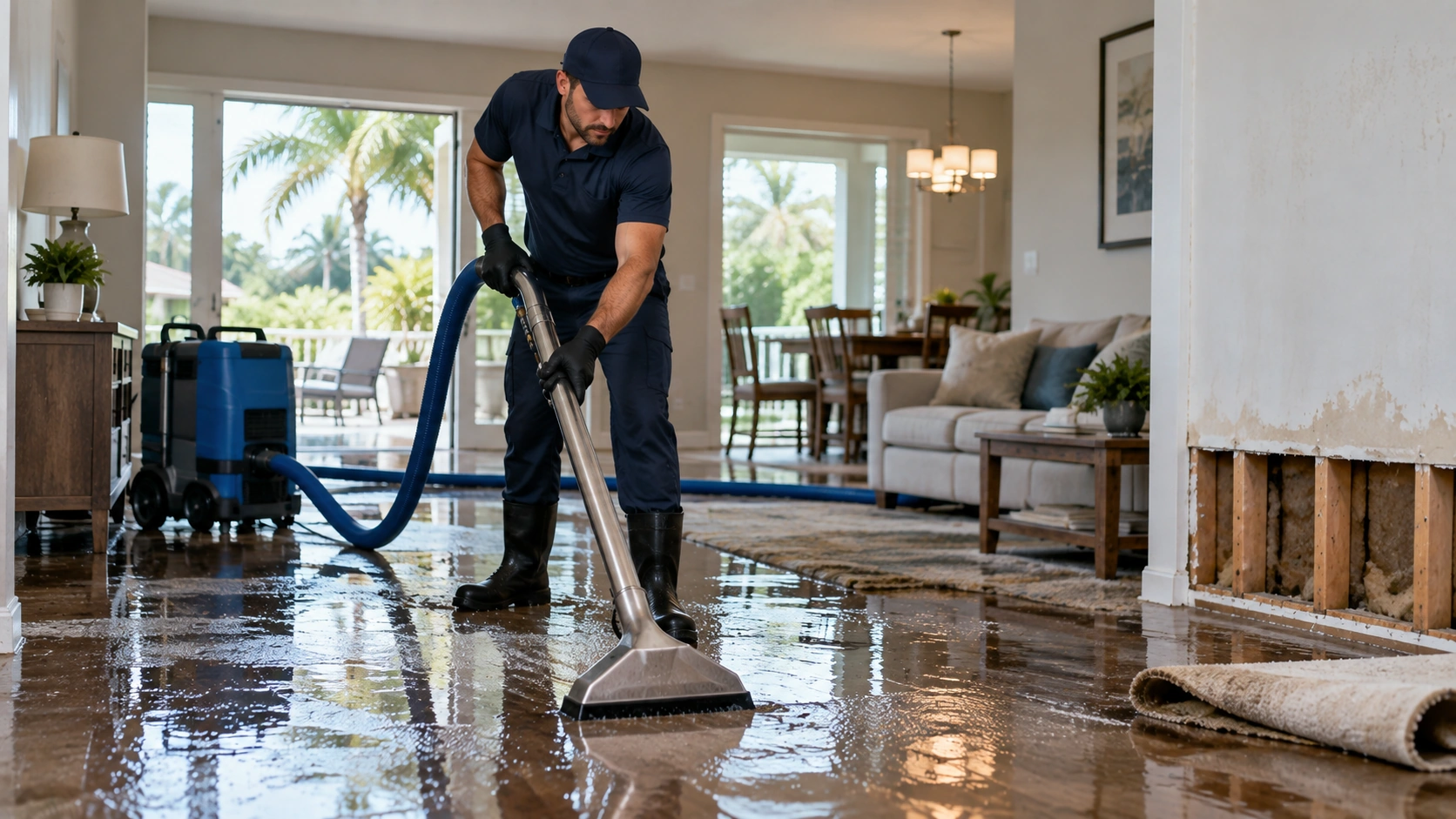
Water damage can come from burst or leaking pipes, failed appliances, water heaters, HVAC condensate, roof leaks, overflowing fixtures, flooding and storm-related water intrusion. The visible water is only part of the problem: porous materials can retain moisture after standing water is removed.
A complete restoration workflow can include assessment, source control, water extraction, moisture detection, structural drying, dehumidification, cleaning, contents handling and repair or reconstruction when affected materials cannot be restored in place.
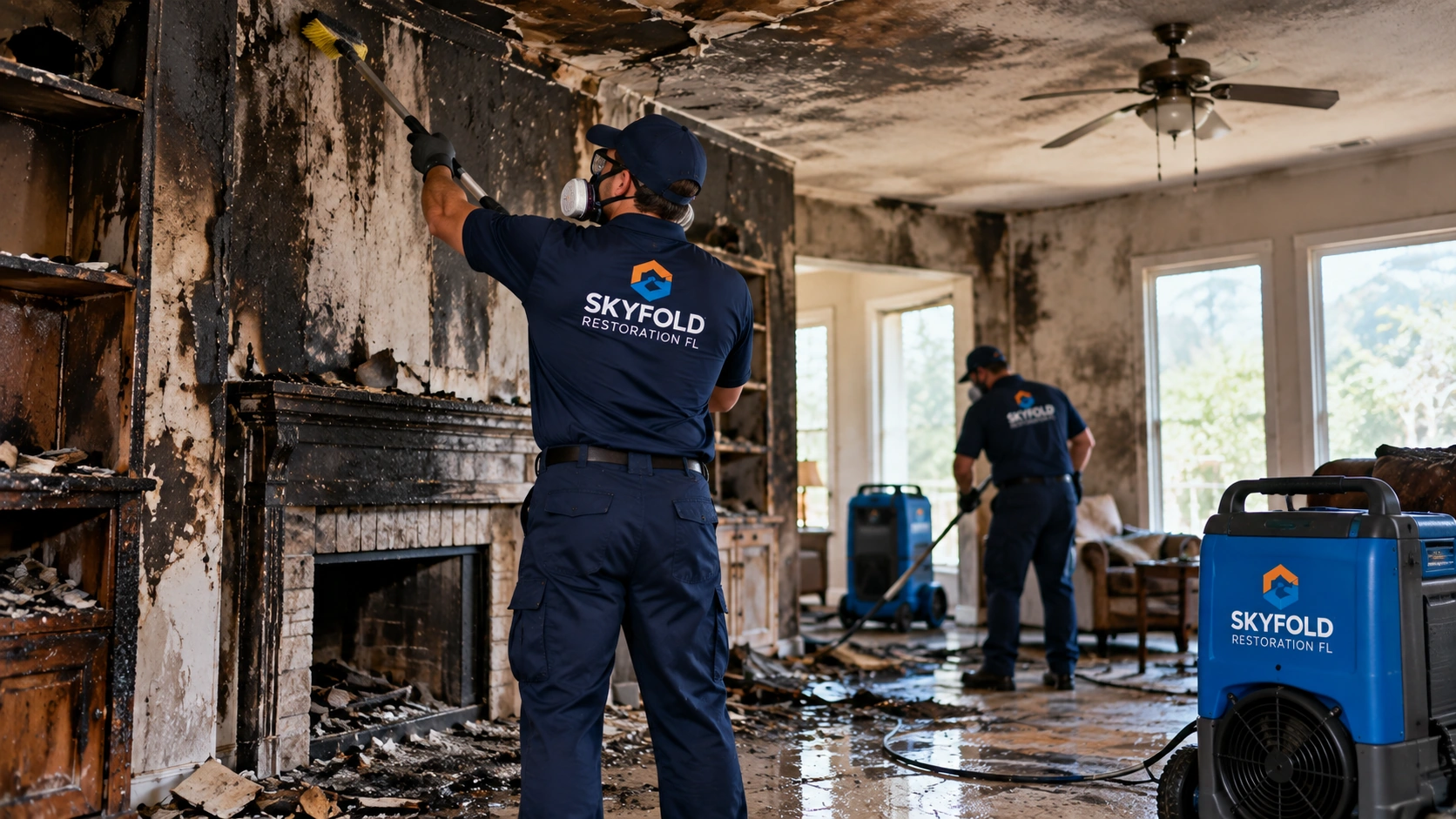
Fire losses can leave several forms of damage at once: flame damage, smoke and soot residues, odor, water from firefighting, damaged contents and building materials that require repair. Restoration starts with stabilizing the property and documenting the loss before cleaning and rebuilding decisions are made.
Depending on the property and severity, the restoration scope may include emergency board-up or protection, soot and smoke cleaning, odor-control work, contents evaluation, moisture assessment after firefighting and repairs to damaged finishes or structural components.

Mold problems are usually connected to a moisture condition that has not been corrected. Leaks, condensation, roof intrusion, wet building materials, plumbing failures and persistent indoor humidity can all create conditions where microbial growth develops.
A responsible remediation scope begins by identifying the moisture source and affected areas, then selecting cleaning, containment, removal and drying measures appropriate to the actual conditions. The goal is not simply to clean a visible surface; it is to address the moisture problem and prevent continued growth.

Biohazard situations can require a different level of cleanup from ordinary water damage. Sewage backups, contaminated water and other biological hazards may affect floors, drywall, contents and porous materials while creating safety and sanitation concerns.
The appropriate response depends on the source, affected materials and the level of contamination. Cleanup planning should prioritize safe access, containment where needed, removal of unsalvageable materials, cleaning and disinfection, and documentation of the work performed.

Florida storms can create overlapping losses: wind damage, roof and opening intrusion, rainwater, flooding, fallen debris and moisture inside walls or ceilings. Restoration often begins with emergency stabilization and then moves into water extraction, drying, cleaning and repairs.
Storm-related restoration can involve protecting exposed areas, removing water and debris, documenting conditions, drying affected materials and restoring damaged finishes. The correct scope depends on the event and the condition of the property when it is assessed.
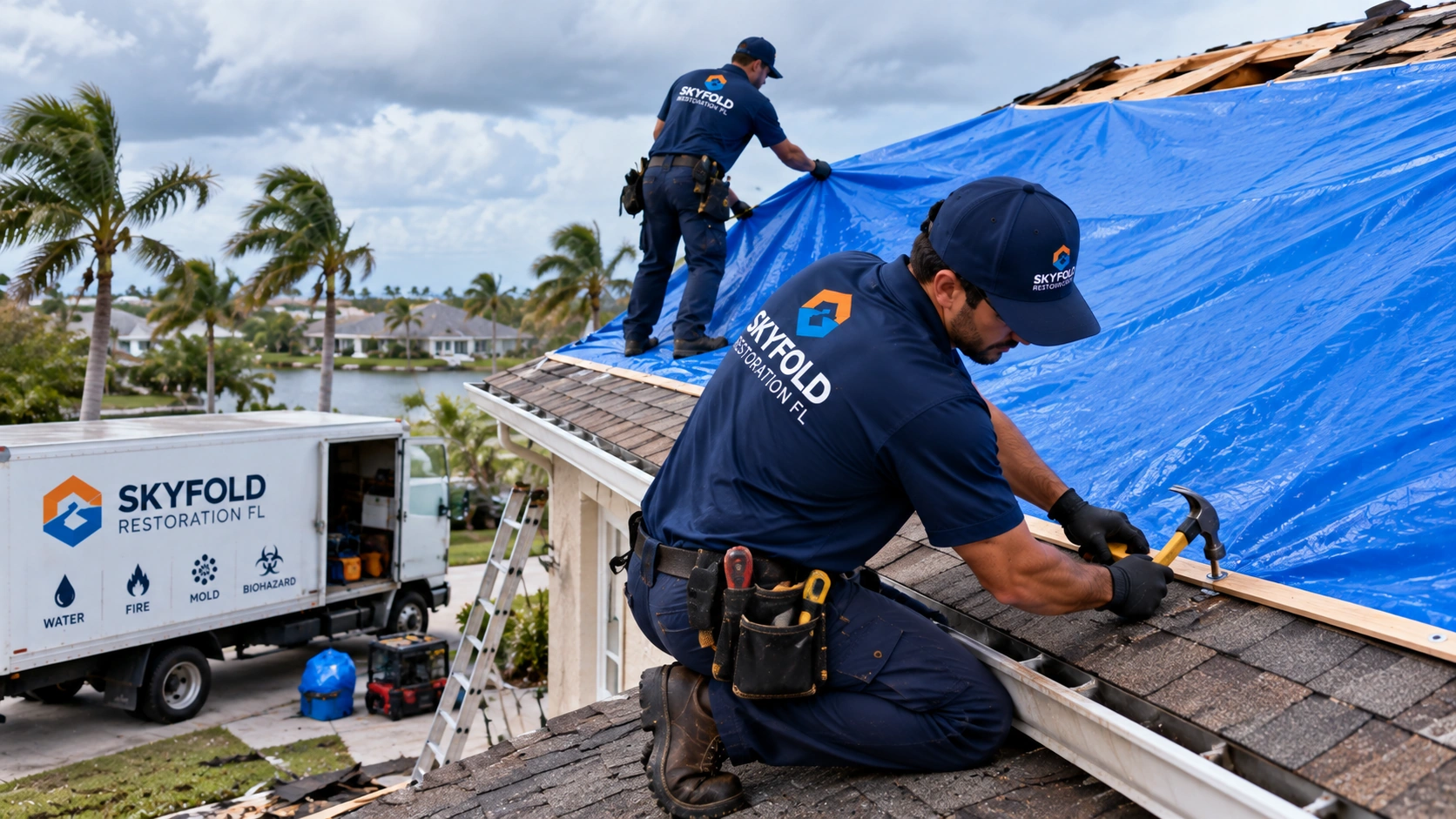
After a storm or sudden roof failure, temporary protection can help reduce additional rain intrusion while the permanent repair scope is evaluated. Roof tarping is an emergency mitigation measure, not a replacement for permanent roof repair or reconstruction.
Where appropriate, the restoration response can include documenting the visible roof and interior damage, protecting affected rooms and contents, extracting interior water and beginning the drying process.
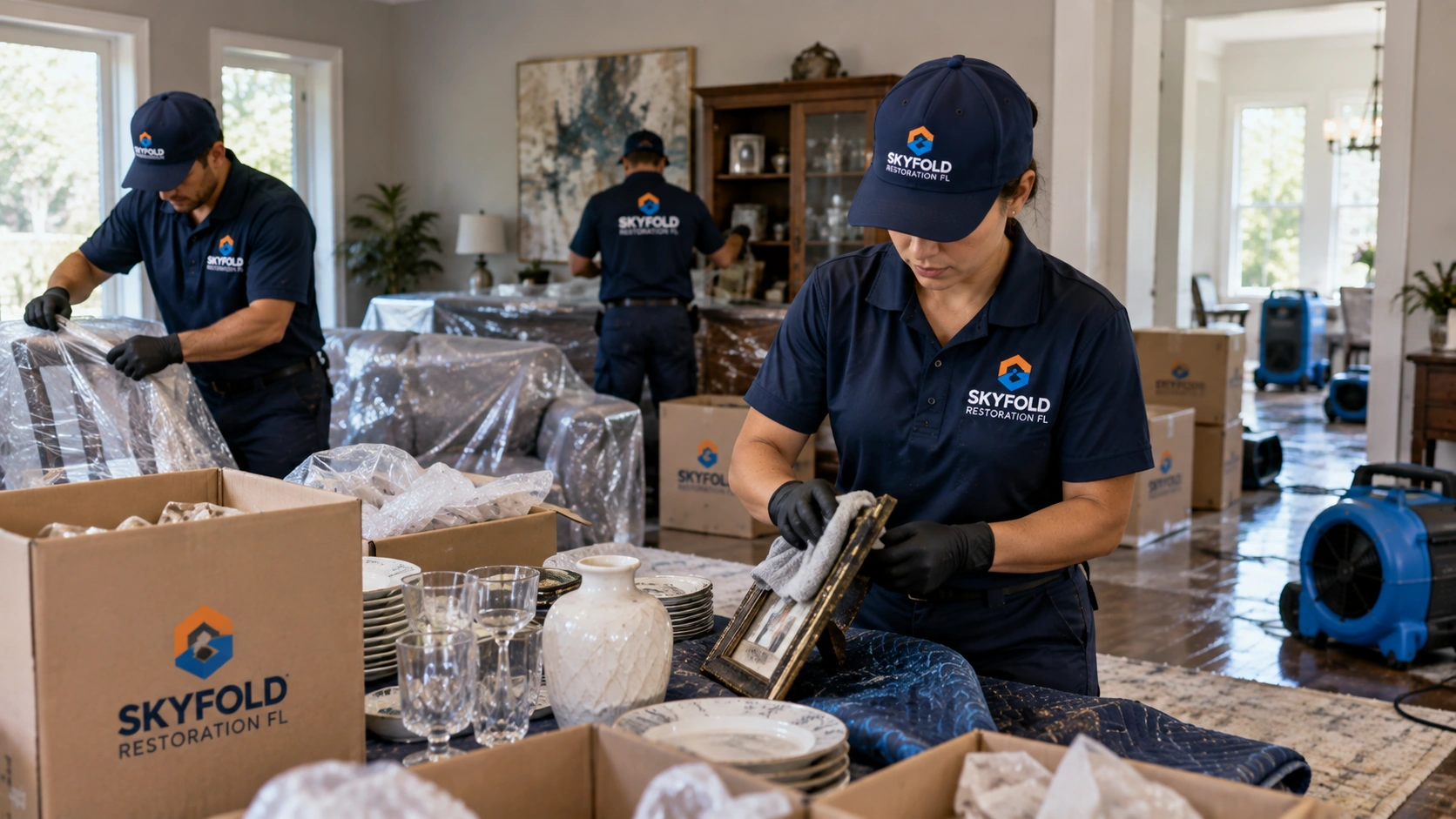
Water, smoke and fire losses can affect furniture, clothing, documents, electronics and other belongings even when the building itself can be dried. Contents restoration involves evaluating what may be cleaned, dried, restored, stored or replaced.
The scope can include item documentation, careful handling, temporary relocation of contents and cleaning or drying appropriate to the material and type of loss.

Commercial properties can have additional restoration constraints involving inventory, tenants, equipment, operating hours, access, common areas and business continuity. A restoration plan should account for both the physical damage and the practical needs of the property.
Florida commercial restoration can include offices, retail spaces, restaurants, warehouses, multifamily properties, managed buildings and other facilities affected by water, fire, mold, biohazard or storm events.
When to call
The service a property needs often depends on the source of damage rather than the room where it occurred. Use these problem pathways to connect a real-world emergency with the appropriate restoration service.
Rapid water release can saturate floors, walls, cabinetry and contents.
Tank or connection failures can affect utility spaces, flooring and nearby finishes.
Condensate problems can create recurring moisture around ceilings and mechanical areas.
Roof intrusion can send water into ceilings, walls and insulation.
Floodwater can affect broad areas, contents and multiple building materials.
Contaminated water requires a more specialized cleanup and restoration approach.
Fire losses can combine smoke, soot, odor, water and structural damage.
Persistent moisture can support growth in hidden and visible areas.
Wind-driven rain and storm damage can create both roof and interior water losses.
Supply hoses, drains or appliance failures can create concentrated water losses.
The restoration response depends on the source and condition of the water.
Hidden plumbing leaks can create moisture that is difficult to locate visually.
Florida-specific restoration
Florida water damage often involves more than a single leak. Hurricanes, tropical storms, heavy rainfall, flooding and constant humidity all affect how water enters a property and how slowly materials dry. Tropical cyclones can produce heavy rainfall and inland flooding, and storm surge can travel inland along suitable terrain and waterways. The National Hurricane Center publishes hazard guidance on the underlying weather.
The sequence varies by property, but the restoration workflow commonly moves from assessment through extraction, drying, monitoring and repair. Timing depends on the property and the conditions of the water loss.
Understand the source, affected areas, urgency and immediate safety concerns.
Evaluate visible and potentially hidden moisture using appropriate inspection tools.
Remove standing water before deeper drying work begins.
Use controlled air movement and humidity management to support material drying.
Address affected surfaces and contents according to the source and condition of the water.
Use repeat observations and readings to track drying progress.
Restore finishes and building components that cannot be recovered in place.
Start with an emergency request or call the team directly.
Request Emergency ServiceCall (833) 606-6010How water losses are classified
Restoration decisions follow the condition of the water and the amount of material that absorbed it. These two scales, category and class, are the industry vocabulary behind terms you will see on an estimate or an adjuster's report.
| Category | Water source | What it usually means for the scope |
|---|---|---|
| Category 1: clean water | Supply lines, water heaters, tub or sink overflow with no contaminants, rainwater that has not contacted contaminated surfaces. | Most affected materials can often be dried in place if the loss is found early. Carpet and pad, drywall and cabinetry are assessed individually. |
| Category 2: grey water | Washing machine and dishwasher discharge, toilet overflow without solids, aquarium water, water that has sat long enough to degrade. | More cleaning and antimicrobial work. Some porous materials such as carpet pad are usually removed rather than dried. |
| Category 3: black water | Sewage backups, rising floodwater from outside, seawater, and Category 1 or 2 water that has been left long enough to become grossly contaminated. | Containment, controlled removal of porous materials, cleaning and disinfection, and documented verification before rebuild work begins. |
| Class | Typical situation | Drying implication |
|---|---|---|
| Class 1 | Small area, minimal absorption, mostly hard surfaces. | Least amount of water to remove; shorter drying window. |
| Class 2 | Whole room affected, water wicked up walls a limited height, carpet and pad wet. | Higher evaporation load; air movers and dehumidification sized to the room volume. |
| Class 3 | Water came from above: ceilings, insulation, walls and subfloor are saturated. | Largest evaporation load. Often needs ceiling or wall cavity access and drilled drying. |
| Class 4 | Deeply held moisture in low-permeance materials: hardwood, plaster, concrete, stone, crawl spaces. | Specialty drying, longer monitoring and sometimes targeted drying systems or controlled demolition. |
Category and class are assessed on site and can change as the inspection progresses. They influence what is dried, what is removed and how the loss is documented for an insurance claim. Water damage restoration Sewage cleanup Insurance documentation

Why drying takes longer here
Drying is evaporation plus removal. Airflow pulls moisture out of wet materials into the air, and a dehumidifier takes that moisture out of the air so the process can continue. If the second half is missing, the moisture simply moves somewhere else in the building, often into cooler wall cavities, cabinet interiors or ceiling assemblies where it causes secondary damage.
Florida's outdoor humidity is the reason "open the windows and run a box fan" fails here for anything beyond a small spill. Outside air in summer frequently carries more moisture than the air inside a closed, conditioned structure, so ventilating can add moisture instead of removing it. Controlled drying (closing the affected area, running dehumidification and directing airflow across wet surfaces) is what actually lowers moisture content.
Progress is measured, not guessed. Moisture meters take readings from affected materials and comparable dry materials in the same building, and those readings are recorded daily. Drying is finished when materials reach a stable, documented dry standard, not when the surface feels dry to the hand.
Mitigation focuses on limiting additional damage through source control, extraction, drying and stabilization. Restoration focuses on returning affected spaces to a usable condition through cleaning, repair, replacement and reconstruction.
A room may be extracted but still require structural drying. A wall may be dried but still need drywall replacement. Insurance documentation may also distinguish emergency mitigation work from later repair or rebuild work.
How structural drying works →Coverage depends on policy language, cause of loss, exclusions, deductibles and other terms. Careful documentation helps, and your insurance carrier or adjuster confirms what your policy covers.
Record the cause, the date and time, and the affected spaces as soon as it is safe to do so.
Take photos or video before moving or removing affected materials, when practical.
Keep estimates, invoices, moisture and drying records, and correspondence with your insurer.
Extraction and drying may be emergency mitigation, while drywall, flooring or cabinetry replacement may be later repair or reconstruction.
Coverage depends on policy language, cause of loss, exclusions and deductibles. Your carrier or adjuster can confirm what applies.
Retain scopes of work, equipment and monitoring logs, and records of the work performed.
This is general information, not legal or insurance advice. Skyfold Restoration cannot guarantee insurance approval or payment. Read the water damage insurance guide →
Property type changes almost everything about a restoration project: how quickly the loss is discovered, who has authority to approve work, how contents are handled, and how much of the building has to stay in use while drying equipment runs.
A single-family home and a 40-unit condo building can have the same burst supply line and completely different restoration plans. In a house, the work usually involves one owner, one insurance policy and one set of affected rooms. In a condo or apartment building, water travels between units and floors, the association and the unit owner may carry separate policies, and the affected area often includes common walls, hallways, elevator lobbies and the units below the loss.
Commercial buildings add operating pressure. A restaurant that cannot open, a medical office with sensitive equipment, or a warehouse with product on the floor all need a plan that separates the wet area from the working area. That usually means containment, staged drying, night or weekend access, and documentation clear enough for a property manager, a tenant and an adjuster to read the same way.
Whatever the property, the fundamentals do not change: find the source, identify every material that got wet, remove standing water, dry what can be dried, remove what cannot, and document moisture readings until materials reach a stable dry standard.

Single-family homes, condos, townhomes, apartments, villas and vacation rentals across Florida deal with supply-line failures, water heater leaks, washing machine and dishwasher leaks, toilet overflows, AC condensate line clogs, roof leaks after storms and slab leaks under the foundation.
Occupied homes need extra planning: where the family sleeps while drying equipment runs, how pets and personal belongings are protected, what flooring has to come up, and how quickly the affected rooms can be returned to normal use.
Offices, retail units, restaurants, warehouses, hotels, medical suites, schools and multifamily buildings carry concerns that go beyond the wet materials: inventory, equipment, tenants, staff, access control, security, after-hours work and business continuity.
Commercial scopes typically need containment between the work area and the operating area, a documented drying plan, coordination with facility staff and paperwork that supports both the property manager's records and the insurance claim.
Supply lines, water heaters, appliances, roof leaks and slab leaks; drying usually centres on flooring, baseboards, drywall and cabinetry.
Water crosses unit boundaries. Association and owner coverage, common areas and neighbouring units all have to be assessed.
Occupied units, stacked plumbing and shared corridors mean staged drying and clear communication with residents.
Losses are often found late by a guest or cleaner, so hidden moisture and secondary damage are more common.
Server rooms, cabling, carpet tile and documents need protection before equipment is set and power loads are added.
Stock, kitchen equipment and health requirements drive the scope; trading hours shape when work can happen.
Large open areas, concrete slabs, racking and palletised product change extraction, airflow and dehumidification planning.
Guest impact, noise limits and room availability mean containment and quiet, staged drying wherever possible.
Restoration scope and access arrangements are agreed for each property before work begins. Commercial & multifamily restoration Residential water damage restoration
Florida service areas
Skyfold Restoration organizes Florida service areas by region, city and ZIP code. Enter a ZIP code to check the coverage directory, or explore a region below.
Miami-Dade, Broward, Palm Beach and Treasure Coast communities in the Florida service-area network.
220 ZIP codes in the coverage directoryExplore South Florida →The Orlando area plus Seminole, Volusia and Brevard communities.
116 ZIP codes in the coverage directoryExplore Central Florida →Tampa, St. Petersburg, Clearwater, Pinellas, Pasco and nearby Hillsborough communities.
137 ZIP codes in the coverage directoryExplore Tampa Bay →Lee, Collier and Charlotte counties plus the Sarasota and Manatee Gulf Coast.
115 ZIP codes in the coverage directoryExplore Southwest Florida →Lakeland, Winter Haven, Sebring and neighboring Polk County and inland communities.
47 ZIP codes in the coverage directoryNortheast Florida and the Panhandle, from Jacksonville to Pensacola.
88 ZIP codes in the coverage directoryExplore North & Northwest Florida →Regions and ZIP codes describe the service-area network, not physical offices. Service availability should be confirmed for the specific property location.
Local coverage
Water damage response is a local problem: a slab leak in Cape Coral, a hurricane roof intrusion in Naples and a condo riser failure in Miami Beach all need different planning. Coverage is organised by region, county and city so you can start from the area your property is actually in.
Miami-Dade, Broward, Palm Beach, Martin, St. Lucie and Indian River counties
Orange, Seminole, Osceola, Volusia, Brevard and Lake counties
Hillsborough, Pinellas, Pasco and Hernando counties
Lee, Collier, Charlotte, Sarasota and Manatee counties
Polk, Highlands, Hardee and DeSoto counties
Duval, St. Johns, Alachua, Marion, Leon, Escambia, Okaloosa and Bay counties
Service availability should be confirmed for the specific property location. Use the ZIP lookup above, or see the full Florida service-area directory with 723 ZIP coverage records.
Clear information, an easy way to reach the team and a plain explanation of how restoration work is done.
See what happens from first contact through assessment, extraction, drying, monitoring and restoration, so the next step is never a mystery.
Browse structured service-area information by region, city and ZIP code, without ZIP codes being presented as physical offices.
Request emergency service online, call (833) 606-6010 or email the team. Every page keeps these options within reach.
Practical guides cover water damage, mitigation, drying, insurance considerations and related restoration topics.
Looking for project examples?
View Restoration Case Studies →Our Location
Our business address is 2247 NW 3rd St, Miami, FL 33125. Skyfold Restoration FL provides restoration services across Florida, with service availability confirmed for the specific property location.
Equipment matters when it is matched to the actual moisture conditions in a property. Air movers, dehumidifiers, moisture meters and thermal imaging are used together: airflow releases moisture from materials, dehumidification removes that moisture from the air, and readings show whether the drying plan is working or needs to change.
In Florida, ambient humidity is part of the problem. Open windows rarely dry a structure here; controlled, contained drying with mechanical dehumidification usually does.
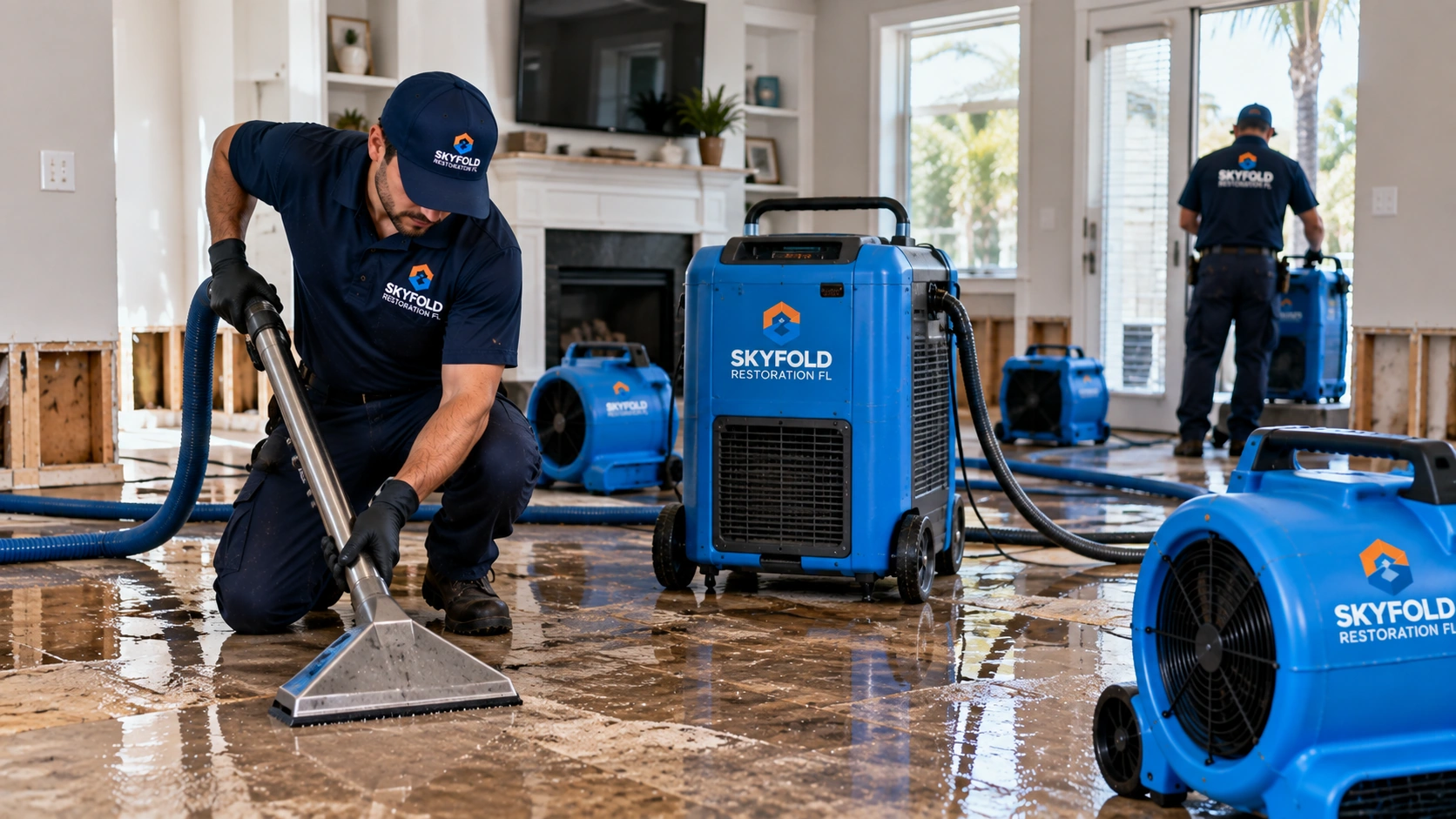
Increase airflow across affected materials to support evaporation.
Remove water vapor and support humidity control during drying.
Provide readings that help assess material moisture and drying progress.
Can identify temperature patterns that warrant further investigation.
Removes standing water before the structural drying stage.
Support repeat observations and drying decisions as conditions change.
There is no single price for every water loss. Actual restoration cost depends on factors such as the source and volume of water, contamination level, affected materials, drying requirements, demolition, repairs and reconstruction scope.
An online estimator can give a broad planning range, but it cannot inspect hidden moisture or determine the final scope of a restoration project. Only an on-site assessment can do that.
Explore how service type, affected area and severity influence a broad restoration range.
Preliminary range
Planning estimate for 850 sq. ft. Not a quote or guarantee.
Planning estimate only. Not a quote or guarantee. Actual restoration cost depends on factors such as the source and volume of water, contamination level, affected materials, drying requirements, demolition, repairs and reconstruction scope.
About the company
Skyfold Restoration is a Florida property restoration company working on water, fire, smoke, mold, storm and biohazard losses for homes and businesses. The business address is 2247 NW 3rd St, Miami, FL 33125, and service coverage is organised across the Florida regions, counties, cities and ZIP codes listed on this site.
Restoration work is organised around the loss type rather than a single product list:
Every job follows the same spine, scaled to the size of the loss:
Restoration paperwork matters as much as the equipment, particularly for a claim:
Most people hire a restoration contractor once, under pressure, with water still on the floor. These are the checks worth making before signing anything, with us or with anyone else.
Related reading: water damage insurance and claims what restoration costs depend on our restoration process what to do in the first 24 hours
General information only; actual work and timing depend on the property and water-loss conditions.
It is the process of assessing a water loss, removing standing water, drying affected materials, addressing cleaning needs and restoring or repairing the property as required.
Stop the source when safe, avoid electrical or contaminated-water hazards, document damage and arrange assessment when standing water or significant saturation is involved.
Extraction removes standing water with appropriate equipment. Moisture can remain in materials after extraction, so drying and monitoring may still be required.
There is no universal duration. Drying depends on water volume, material type, humidity, temperature, airflow, dehumidification and access. Progress is confirmed with moisture readings rather than a fixed schedule.
Yes. Moisture can remain beneath flooring, inside drywall, in wall cavities, subfloors and other concealed areas, which is why moisture mapping is part of the inspection.
Mitigation limits additional damage through source control, extraction, drying and stabilization. Restoration can involve cleaning, repairs, replacement and reconstruction.
Coverage depends on the policy and the cause of loss. Sudden and accidental losses such as a burst supply line are treated differently from long-term seepage or rising floodwater, which usually needs separate flood coverage. Document the damage and confirm coverage with your carrier or adjuster.
There is no single price. Cost depends on the source and volume of water, contamination category, affected materials, how much drying equipment is needed and for how long, plus any demolition, repairs or reconstruction. The planning tool on this page gives a broad range, not a quote.
Microbial growth can begin within roughly 24 to 48 hours in the right conditions, which is why wet materials are addressed quickly rather than left to dry on their own.
Common causes include plumbing and supply-line failures, water heater and appliance leaks, AC condensate problems, roof leaks and wind-driven rain, slab leaks, sewage backups, and flooding during tropical weather.
They describe increasing contamination risk: clean water from a supply source, grey water from appliances or degraded clean water, and black water from sewage or flooding. The category affects what can be dried and what has to be removed.
Florida outdoor air is often more humid than the air inside a conditioned building, so ventilating can add moisture rather than remove it. Controlled drying uses contained airflow plus mechanical dehumidification.
Yes. Sewage-related losses involve contaminated water and specialised cleanup, containment and disposal. The scope depends on the affected spaces, materials and conditions.
Yes. Commercial restoration can include offices, retail, restaurants, warehouses, hotels, medical suites, condo associations and managed facilities, with tenant access and business operations factored into the plan.
It depends on the affected area, the water category and where equipment has to run. Many losses allow occupancy in unaffected areas; contaminated-water losses and large demolition scopes often do not.
It is a document that transfers your insurance claim rights for the work to the contractor. It is common in Florida restoration work. Read it fully before signing and ask what it allows the contractor to do on your behalf.
As soon as the area is safe. Absorbed moisture continues to travel through materials, and delays generally increase the amount of material that has to be removed rather than dried.
Skyfold Restoration organises its Florida service areas by region, county, city and ZIP code. Service availability should be confirmed for the specific property location using the ZIP lookup or by calling (833) 606-6010.
Emergency help
Whether the loss involves a burst pipe, appliance leak, roof intrusion, flooding, storm water or sewage backup, start by identifying the source and the affected areas of the property.